As you all know Move@Work started on 13/09/21. But the journey did not started officially then, various things had to completed before. Let me tell you about it.
It all started when me and colleagues came back from redeployment, as we were helping out other services due to the arises pressures of the COVID pandemic. I was having supervision with my senior when the conversation about wellbeing came up. I was questioned about any ideas to promote staff wellbeing, my answer was a straight “yes, let’s talk about it” and then is when Move@Work project started with another name initially – “Chair Yoga” – it was trialed for four sessions with my Physiotherapists colleagues.
At the end after their feedback I discussed it with my Clinical Manager and presented to idea to all the Community and Rehabilitation and Falls Service Team (CRAFS).
Pre-start of Move@Work
Before officially begin, data had to be gathered to understand CRAFS line of work from inside out by knowing the physical, mental and environmental demands from your day-to-day work life.
An initial questionnaire was given online via a link using goggle platform. After a month I got 13 answers (I know is not much, but is something). I am here to talk about some of the answers for who ever is reading to understand what I found.
Sample Selection – A groups of professionals were selected in the month of September 2021. It consists of professionals working in the Community Rehabilitation and Falls Service, from administrative sector and therapeutic sector. Sample consists of people who work in the community setting for a NHS Trust, with involvement of patient related and office activities.
Discussion of the main aspects:
Commute:
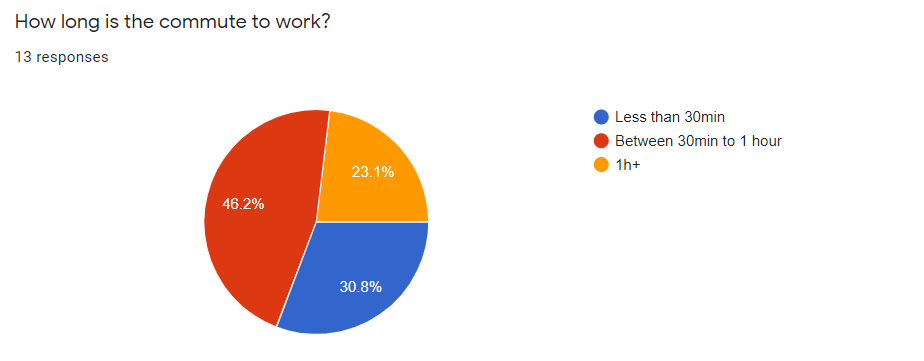
Fig 1 we can understand how long is the commute of the staff. We can wee that near half takes between 30min to 1h (46.2%)
Physiological/Physical Aspect related to work:
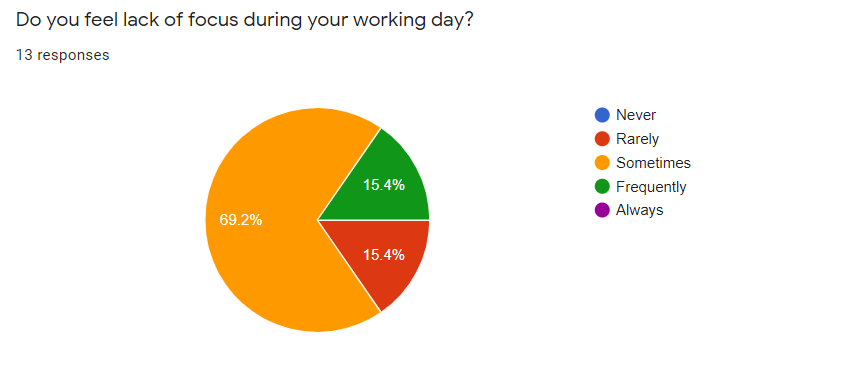
On Fig 2 we want to understand if staff presents lack of focus during the day and we had big percentage responding that Sometimes (69.2%) they feel that their focus is lacking
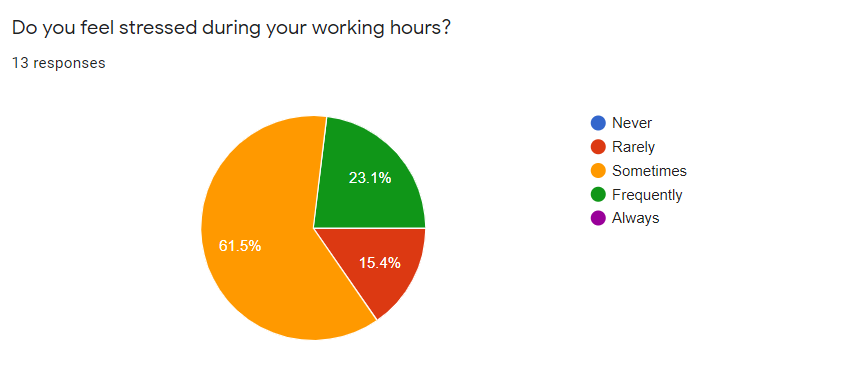
Fig 3 we see that 61.5% of the staff feels stressed duting work hours. But we can see that 23.1% feels it frequently/
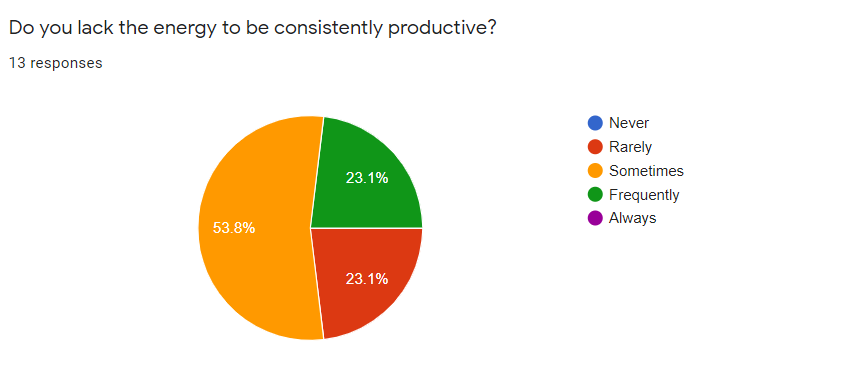
Here (Fig 4) we dag onto the energy level of the staff. With the answer we can see that staff sometimes feels energy levels low (53.8%)
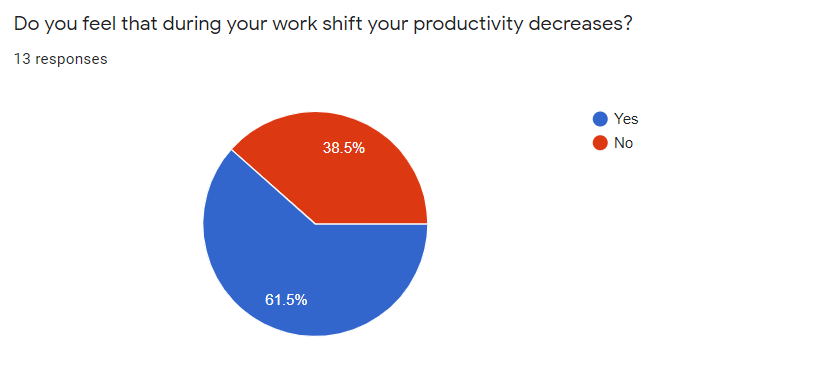
In Fig 5 we see that 61.5% responded that yes, they lose productivity during the day
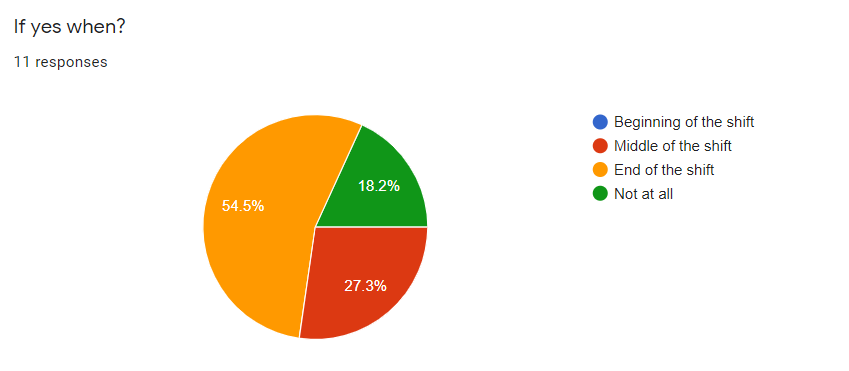
Dependent of the response of Fig 5. Fig 6 is where we see where staff starts losing productivity. More that half responded at the end of the shit (54.5%)
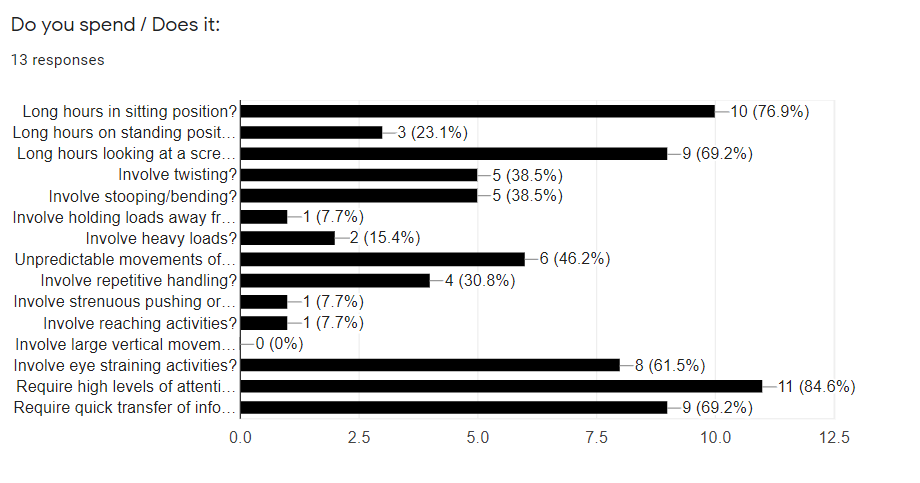
Fig 7 show what happens during work day of the staff, what it involves when performing work activities. We see that high levels of attention is more predominate in the work they do (84.9%) but we can also understand that long hours on sitting position (76.9%), looking long hours at a screen as requiring a quick transfer of information (69.2%)
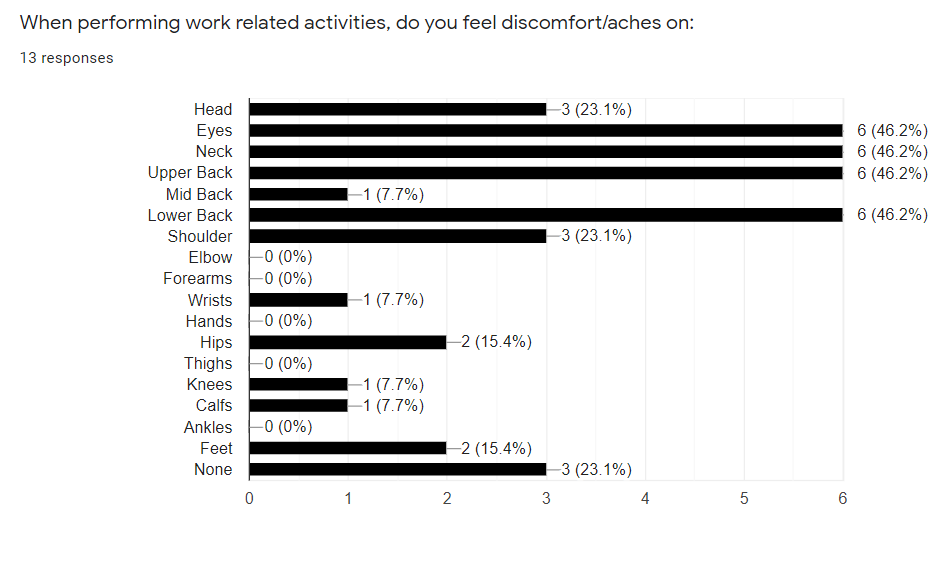
Here in Fig 8 we see that the most common discomforts are located on eyes (46.2%) and various parts of the back, more prevalence on mid back (46.2%) and lower back (46.2%)
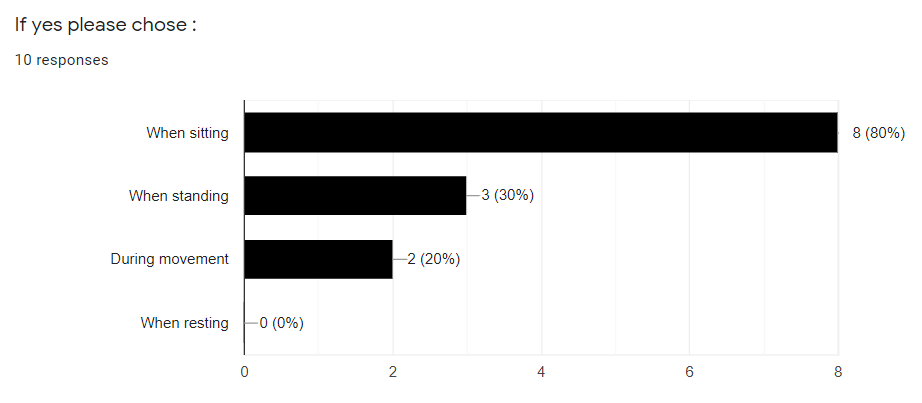
In Fig 9 it relates to if staff had positive discomfort on their body. We can see that most of the discomfort happens when they are on sitting position.
Conclusion:
Thanks to the questionnaire and although the low response levels from the CRAFS Team we can see a relation of the the discomforts ; the type of activities performed during work day ; commute time.
Let me explain: we see that having a commute of 30min to 1h (possibly buy bus, train, car) people are passing a lot time in a sitting position, plus the “long hours sitting” described by then, on what type of activities do they work involves.
Also this can have relation with the discomfort location – lower back , mid back which tells me that staff will pass a long time sitting during the all day, lets say and average of 4-5h a day sitting and possible with poor postures.
This questionnaire was good for me to understand on where should I act when performing Move@work sessions!